
Every investor has felt the squeeze. The market is moving, the window is closing, and you have a choice to make. Move fast and you worry you missed something important. Slow down to be thorough and the opportunity is gone before you finish reading. It feels like you have to pick one, speed or care, and that whichever you choose will eventually cost you.
Here is the good news. That tradeoff is mostly a myth. Speed and thoroughness only fight each other when your process is slow. Fix the process and you can have both. The key is real-time market data decisions, where the analysis happens at the same pace as the market instead of lagging behind it.
Why Speed and Thoroughness Feel Like Enemies
The reason this tradeoff feels so real is that, for most people, being thorough is genuinely slow.
Think about what a careful decision usually involves. You check the latest price. You open the most recent earnings. You scan the news. You compare the company to a couple of peers. You glance at the broader market and maybe a macro signal or two. Each step lives in a different tab or app, and each one takes time to find, read, and interpret. By the time you have gathered everything, twenty minutes have passed and the setup you were looking at has changed.
So people start cutting corners to keep up. They skip the peer comparison. They trust a headline instead of reading the actual report. They act on a single chart because pulling the full picture takes too long. The corners they cut are exactly the ones that protect them from mistakes, which means fast decisions quietly become worse decisions.
The problem was never speed. The problem was that thoroughness was tied to manual effort, and manual effort does not scale when the clock is running.
The Hidden Cost of Deciding Too Slowly
It is easy to focus on the dramatic losses, the bad trade or the position that blew up. The slow, quiet costs are harder to see, but over time they add up to far more.
Think about the entries you missed because you were still reading when the price moved. Think about the times you watched a setup play out exactly as you expected, except you were not in it, because the research took too long and you talked yourself out of acting. Those are not headline losses. They never show up as a red number on your account. But they are real money you did not make, and they happen constantly when your process cannot keep pace with the market.
There is an emotional cost too. Every time you hesitate and then watch the move happen without you, your confidence takes a small hit. After enough of those moments, you either start forcing rushed trades to make up for it or you freeze even harder the next time. Slow decisions do not just cost you opportunities. They slowly erode the trust you have in your own judgment, which is the one thing you cannot afford to lose as an investor.
The Real Bottleneck Is Synthesis, Not Information
It is tempting to think the fix is faster reading or more screens. It is not. The bottleneck is synthesis, the work of turning many separate inputs into one clear answer.
You can have every data point in front of you and still freeze, because your brain has to weigh them all against each other in real time. Is the price move big relative to history or normal? Does the earnings beat matter if the sector is selling off? Is this a real breakout or noise? That mental juggling is where the minutes disappear, and it is also where tired investors make their worst calls.
This is the same reason information overload backfires. More inputs do not make the decision faster, they make the synthesis harder. If you have ever opened fifteen tabs and ended up more confused than when you started, you have felt it directly. This is also why a tool built for decisions beats one built for search, a difference we break down in Incite AI: The AI Investing App That Makes Better Decisions.
The way out is not to do the synthesis faster by hand. It is to let something else do it for you, the moment you ask.
How Real-Time Data Fusion Removes the Tradeoff
When live data is fused together automatically, the entire equation changes. Thoroughness stops costing time because the gathering and weighing happen in the background, in seconds, not in twenty minutes of manual tab-hopping.
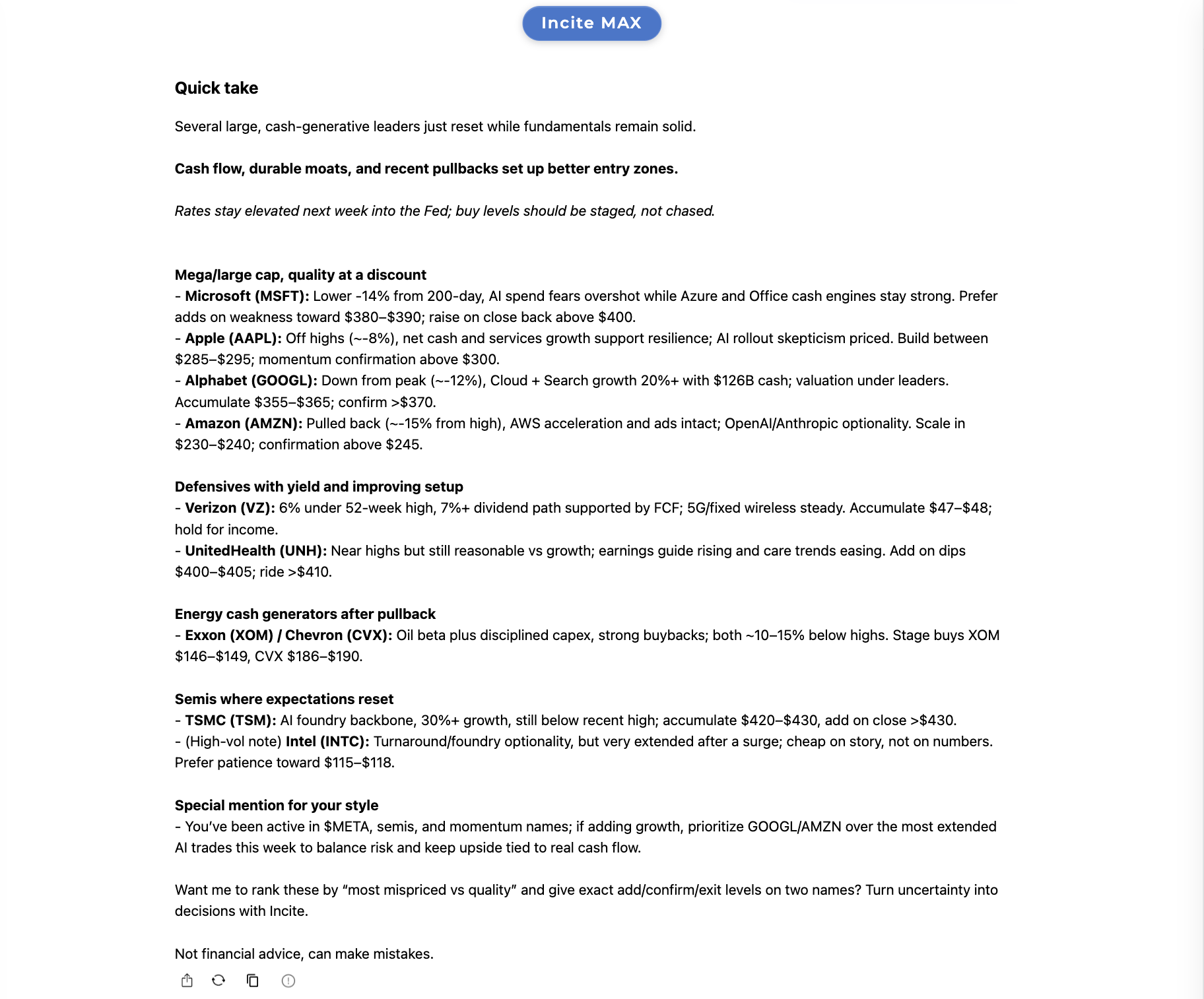
This is the core idea behind Incite AI. Instead of handing you links to read, it pulls thousands of live data points and processes them together in real time. Price action, fundamentals, recent earnings, technicals, peer comparisons, and macro signals all get fused into one clear read you can act on right away. You are not choosing between fast and careful anymore, because the careful part already happened by the time you finished asking the question.
That is what real-time market data decisions actually look like in practice. You ask about a stock or a coin, and within seconds you get a complete, context-aware answer rather than a pile of raw inputs to sort through yourself. The thoroughness is baked in. The speed is the natural result.
It is a different job than search or chat. A search tool reads pages. A chat tool summarizes them. Incite assembles live market data and tells you what it adds up to right now, which is the part that used to eat all your time. If you want a deeper look at how that compares to traditional research tools, our Bloomberg Terminal for Crypto breakdown walks through the difference.
What a Fast, Thorough Decision Looks Like Step by Step
It helps to see the difference play out on a real situation. Say a stock you follow just gapped up six percent before the open and you have to decide whether to chase it, wait, or stay out.
The old way looks like this. You open the price chart in one tab, hunt for the news that caused the move in another, pull up the last earnings report in a third, and try to remember how the sector has been trading. Twenty minutes later you have a rough picture, the gap has already started to fade, and you still are not sure if the move is justified. You either jump in late or give up and miss it.
The fused way looks different. You ask one question and within seconds you have the size of the move relative to the stock's own history, the catalyst behind it, how peers are reacting, where the technicals sit, and whether the broader market supports the move or fights it. Nothing was skipped. You looked at everything that mattered, and you did it before the opportunity changed shape. That is the whole point. You were not faster because you were sloppier. You were faster because the slow part was handled for you.
A Simple Way to Decide Faster Starting Today
You do not need to overhaul your whole approach. A few habits make a big difference right away.
First, define your decision before you research, not after. Decide what you are actually trying to answer, like "should I add to this position or wait," so you are not wandering through data with no target. A clear question is the single fastest way to cut research time.
Second, gather context in one pass instead of many. The slow part is bouncing between sources, so the fix is pulling the full picture at once. This is exactly where a real-time fusion tool earns its keep, because it collapses the many-tab problem into one answer.
Third, separate the read from the reaction. Get the objective picture first, then decide how you feel about it. Reversing that order is how panic and hype creep in, especially in fast-moving markets that never give you a quiet moment to think.
Do those three things and you will notice the tradeoff start to dissolve. You move quickly because the heavy lifting is handled, and you stay thorough because nothing important got skipped.
But Isn't Fast Just Reckless?
This is the fear that keeps careful investors stuck, and it deserves an honest answer. Fast can absolutely be reckless, but only when speed comes from skipping steps. That is the version most people picture, the impulse buy on a tip with no research behind it.
The kind of speed we are talking about is the opposite. It is fast because the research is complete, not because it was abandoned. When you can see the full picture in seconds, acting quickly is not a gamble, it is a response to information you actually have. Recklessness is moving without knowing. Real-time market data decisions are about moving precisely because you know.
The slowest investors are not always the safest ones, either. Hesitation has its own risks, from missed entries to selling into a panic you did not have time to think through. Speed and safety are not opposites when the speed is built on real data. The reckless investor and the frozen investor are both reacting to the same problem, which is not having a clear read fast enough to trust.
Fast and Careful Are Not Opposites
The investors who do well in live markets are not the ones who are simply faster or simply more careful. They are the ones who stopped treating those as a choice. When real-time data does the synthesis, you get speed and thoroughness in the same motion, and you make the call while it still matters.
Ready to make faster decisions without cutting corners? Try Incite AI and see how quickly a complete, confident read can come together.