
You sit down to make one simple call on a stock you have watched for weeks. Forty minutes later you have eleven tabs open, three contradicting hot takes from finance Twitter, a half-read earnings summary, and a chart you do not fully understand. You still have not decided anything. So you close the laptop and tell yourself you will "look at it tomorrow."
If that sounds familiar, you are not lazy and you are not bad at investing. You are dealing with decision fatigue, and it quietly costs people real money every single week.
What Decision Fatigue Actually Does to Investors
Decision fatigue is the mental drain that builds up every time you weigh options. Your brain treats choices like a battery. Each comparison, each "should I or shouldn't I," draws a little more charge. By the time you reach the choice that actually matters, the battery is low and the quality of your thinking drops.
In everyday life this is annoying. In investing it is expensive.
Decision fatigue investing shows up in a few predictable ways. First, you default to doing nothing. You sit in cash or hold a losing position long past the point you meant to act, simply because deciding feels like too much. Second, you make sloppy, impulsive moves just to end the discomfort. You buy the thing everyone is talking about because researching the better option feels exhausting. Third, you start trusting the loudest voice in the room instead of the best information, because outsourcing the choice is easier than making it yourself.
None of these are character flaws. They are the natural result of asking a tired brain to process too much.
Why Modern Markets Make It So Much Worse
Twenty years ago, an everyday investor had a few sources of information and plenty of time to read them. Today the problem is reversed. You have unlimited information and almost no time, and the information rarely agrees with itself.
Think about what goes into a single "good" decision on one stock. You would want the latest price action, the fundamentals, the most recent earnings, how the company stacks up against its peers, what the broader market is doing, and whatever macro signals might move the whole sector this week. That is six or seven research jobs for one ticker. Multiply that by a watchlist of fifteen names and you can see why people freeze.
The tabs pile up. The opinions multiply. Every newsletter, video, and thread adds another input without removing any of the work. You are not short on data. You are drowning in it. And the more you take in, the harder the final decision becomes, which is the exact opposite of what all that research was supposed to do.
This is the trap. We collect information to feel more confident, but past a certain point each new data point makes us less decisive, not more.
The Fix Is Not More Information. It Is Better Synthesis and Better Tools.
Here is the shift that changes everything. The goal of research was never to read the most pages. The goal was to reach the right decision with confidence. Those are two completely different targets, and most investors are aiming at the wrong one.
What you actually need is synthesis. You need something that can gather every relevant signal, weigh it against the market context, and hand you one clear read instead of fifty raw inputs you still have to interpret yourself. You need fewer decisions, not more data.
That is the entire idea behind Incite AI.
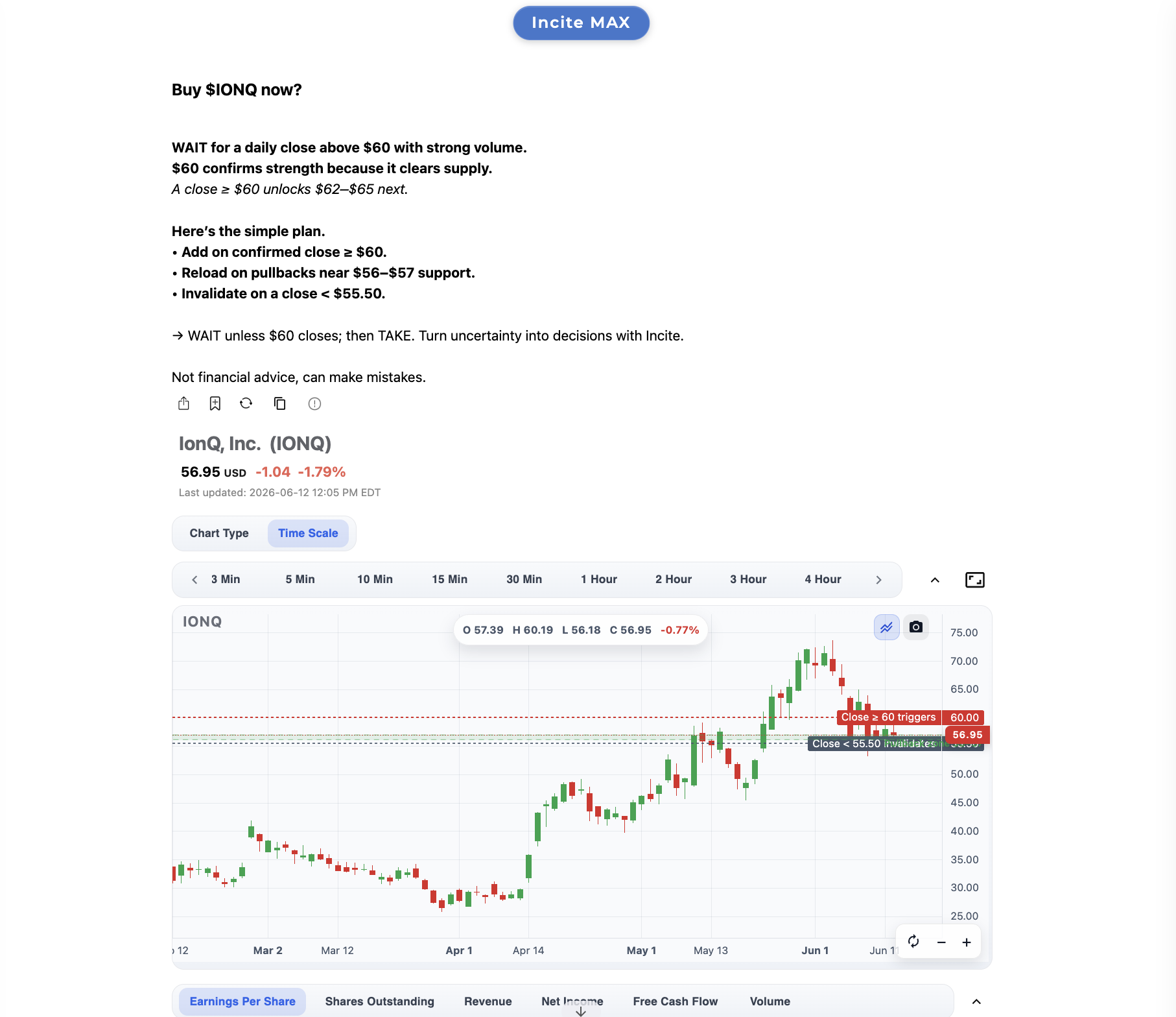
Incite is built as decision intelligence, not another search box. Ask it about a stock or a coin and it pulls thousands of live data points in seconds. Price action, fundamentals, technicals, recent earnings, peer comparisons, and macro signals all get processed together, in real time, and fused into one straight answer you can act on. It does the part that drains your battery so you can spend your energy on the actual decision.
The difference is worth sitting with. A search tool reads pages and hands them back. A chat tool summarizes what it found. Incite assembles live market data and tells you what it adds up to right now. You go from "here are forty things to consider" to "here is the call, and here is why," which is exactly the step where decision fatigue investing usually breaks people.
What This Looks Like in Practice
Say it is earnings season and you are staring at a stock that just reported. Normally this is a decision fatigue minefield. The headline number looks fine, but the stock dropped anyway. Is that an overreaction or a warning? You would usually open ten tabs and still feel unsure.
Instead you ask Incite. In seconds you get the live price reaction, how it compares to the company's own history, how peers are trading, where the technicals sit, and what the broader market is doing, all woven into one clear read of whether the move looks like noise or a real signal. You did not skip the analysis. You skipped the exhaustion.
Crypto makes the point even sharper. Those markets never close, which means the decision fatigue never gets a night off either. A coin can move twenty percent while you sleep, and waking up to that move with no context is a recipe for a panicked, tired choice. Asking a tool that already processed the overnight action, the volume, and the broader market mood gives you a calm starting point instead of a frantic one. You get the read first and the emotion second, which is the right order.
Now picture that across your whole watchlist. The energy you used to burn opening tabs and refereeing contradictory opinions goes back into making sharp, timely calls. You stop defaulting to "tomorrow." You stop buying things just to end the discomfort. You make decisions while they still matter, because timing and context shift constantly in live markets and a stale answer is often a wrong one.
It also builds a habit worth keeping. When the research step stops being a slog, you start checking before you act instead of acting on a gut feeling and hoping. Over months, that small change compounds. Fewer impulse trades, fewer frozen moments, and a lot more decisions you can actually explain to yourself afterward. Good process beats good intentions, and process is far easier to follow when it does not drain you every time.
Protect Your Best Thinking
Your judgment is the most valuable thing you bring to investing, and it is a limited resource. Every pointless comparison you force your brain to run is judgment you will not have for the choice that counts. The investors who do well over time are not the ones who consume the most information. They are the ones who protect their decision-making energy and aim it where it matters.
Decision fatigue is beatable. You just have to stop trying to win it with willpower and start winning it with better tools.
Ready to trade tab overload for one clear call? Try Incite AI and see how fast a confident decision can feel.